Ten thousand years before the Dark Portal opened, Azeroth survived the Burning Legion’s first great invasion. Victory destroyed much of the continent its defenders were trying to save. The War of the Ancients ended Azshara’s empire, divided ancient Kalimdor and left disputes about magic that would shape elven society for millennia.
Its history is told across game quests, Blizzard’s historical texts and Richard A. Knaak’s novels. The novels add visitors from the future; later game stories revisit individual survivors. Keeping those perspectives distinct makes the war easier to follow, especially when an orc appears among heroes who lived thousands of years before the Horde reached Azeroth.
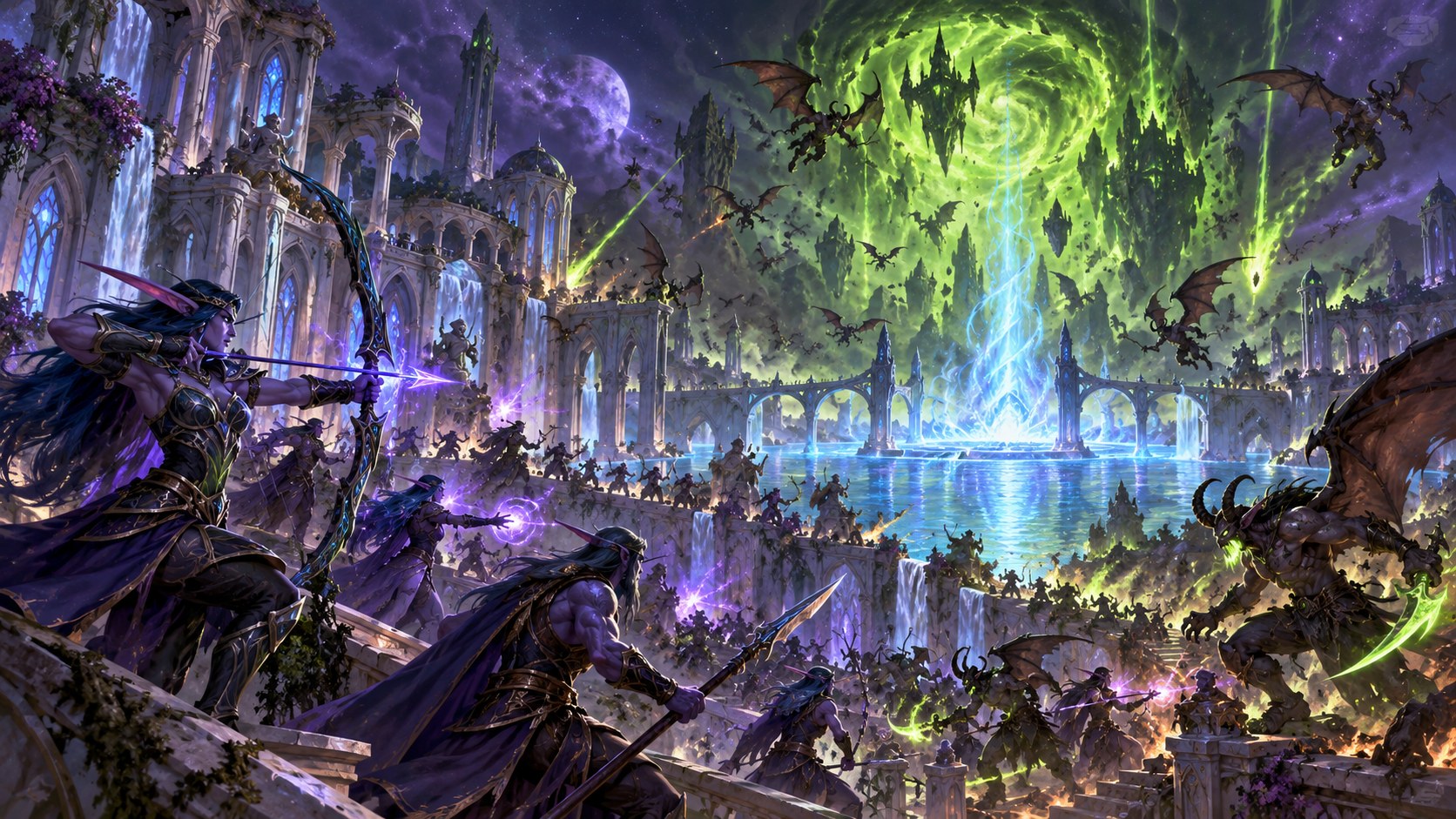
Cover: Night elf defenders confront the Legion near the Well of Eternity. Original AI-generated Azeroth Chronicle illustration; a conceptual reconstruction.
Azshara’s invitation
The Well of Eternity sustained the night elves’ extraordinary command of arcane magic. Beside it stood Zin-Azshari, the imperial capital, where Queen Azshara and her privileged Highborne pursued ever greater power. Their experiments drew the Burning Legion’s attention. Through her adviser Xavius, the queen embraced Sargeras’ offer of a remade world reserved for those she considered worthy.
That ambition made the invasion possible. Azshara expected the destruction of supposedly inferior peoples to improve her empire. Her sorcerers opened a passage for demons and worked toward a portal powerful enough for Sargeras himself. The Legion’s arrival exposed what that bargain meant for ordinary night elves, including inhabitants of the queen’s own capital.
Azshara’s vanity was politically consequential. A ruler accustomed to devotion treated an invading power as a partner in her personal ascent. The people outside her favored circle were expendable before the first demonic army marched.
The captain who learned to command an alliance
Resistance initially gathered around Lord Kur’talos Ravencrest. After his assassination, noble birth proved a poor qualification for command. His successor, Lord Desdel Stareye, underestimated the fighting abilities of other peoples and died during the campaign. Jarod Shadowsong, a comparatively obscure guard captain, gradually took responsibility for an army that needed cooperation more than aristocratic precedence.
Jarod helped bring night elves, tauren, earthen and other defenders into a common effort. Cenarius and the ancient demigods also fought against the Legion. Their participation never made the war safe; even beings revered for generations could fall in battle.
One smaller story captures how those alliances formed. Huln Highmountain saved Jarod and offered to carve his name on his spear in remembrance. Legion’s Highmountain quests later revisit Huln’s deeds, including his rescue of the creature Eche’ro and the blessing associated with his people’s antlers. The tauren were participants in Azeroth’s defense long before the modern factions existed.
Resistance inside the empire
Azshara also faced opposition among her own subjects. In Azsuna, Prince Farondis tried to stop the queen’s plans by turning the power of a Pillar of Creation against the Well. She discovered the attempt and punished his people. When players reach Azsuna in Legion, their unresolved anger and ghostly existence preserve the consequences of that failed rebellion.
The story complicates any account that treats every Highborne as a willing servant of the Legion. Dath’Remar Sunstrider and his followers also broke with Azshara. Their later refusal to surrender arcane magic would cause another rupture, but it should not erase their resistance during the invasion. The empire contained collaborators, rebels and communities trying to survive decisions made far above them.
Neltharion turns on the defenders
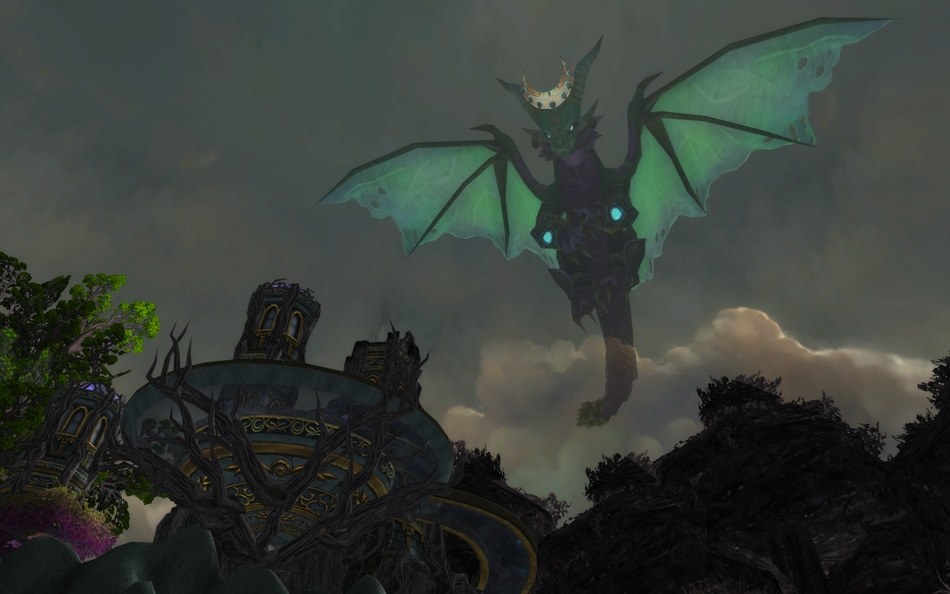
The dragons brought immense power to the resistance. Neltharion, the Earth-Warder, proposed concentrating their strength in a golden disk called the Dragon Soul. The other Aspects contributed their power. He withheld his own contribution and concealed the corruption driving his plan.
When he used the artifact, its victims included Azeroth’s defenders as well as demons. The blue dragonflight suffered catastrophic losses. The weapon that was supposed to help defeat the invasion gave Neltharion leverage over his fellow Aspects; it became known as the Demon Soul, while its creator emerged as Deathwing.
The disk subsequently became involved in the struggle over the Legion’s portal. Its history therefore connects two betrayals within the same war. Azshara let the enemy into her empire, and an Aspect attacked allies who had trusted him with their power. The defenders had to survive both while the invasion continued.
Illidan and the warrior from the future
Illidan Stormrage approached the Legion while pursuing his own plan to defeat it. Sargeras burned away his eyes and granted him magical sight, along with markings of power. His apparent change of allegiance deepened the distrust surrounding him, even though he ultimately helped oppose the invasion. His conviction that dangerous magic could be turned against its masters would outlast the war.
Knaak’s War of the Ancients trilogy adds another complication. A temporal disturbance brings the mage Rhonin, the dragon-mage Krasus and the orc veteran Broxigar into this distant past. Their presence belongs to the novels’ time-travel account. It does not mean an ancient Horde expedition fought beside the night elves.
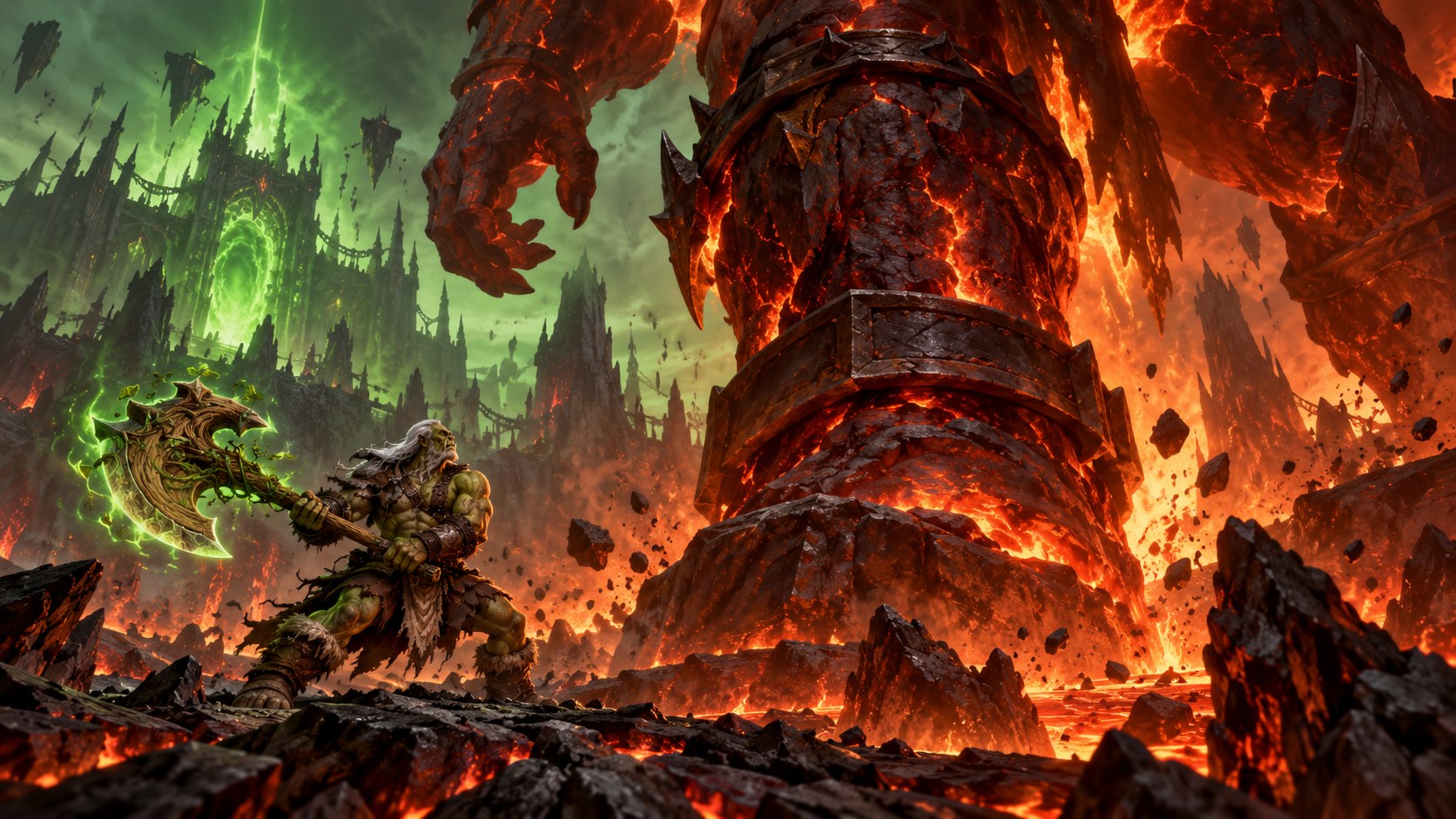
Broxigar’s final stand is among the trilogy’s most memorable episodes. Armed with the enchanted wooden Axe of Cenarius, he passes through the portal and fights the demons beyond it. He manages to wound Sargeras before being killed. The injury provides a brief distraction during the effort to close the passage. His achievement lies in creating that opportunity against an overwhelmingly stronger enemy; Sargeras survives.
The victory that caused the Sundering
The final struggle centered on preventing Sargeras from entering Azeroth through the Well. Malfurion and his allies succeeded in closing the Legion’s passage, but the forces unleashed around it destabilized the Well itself. Its collapse triggered the Great Sundering. Vast areas of ancient Kalimdor disappeared beneath the ocean, and the surviving lands became separated by the newly expanded seas.
The Maelstrom marks the site of that catastrophe. It is easy to remember the war as a successful defense and overlook what survival cost. The capital was lost, settlements vanished and survivors could no longer assume that distant communities remained reachable—or even existed.
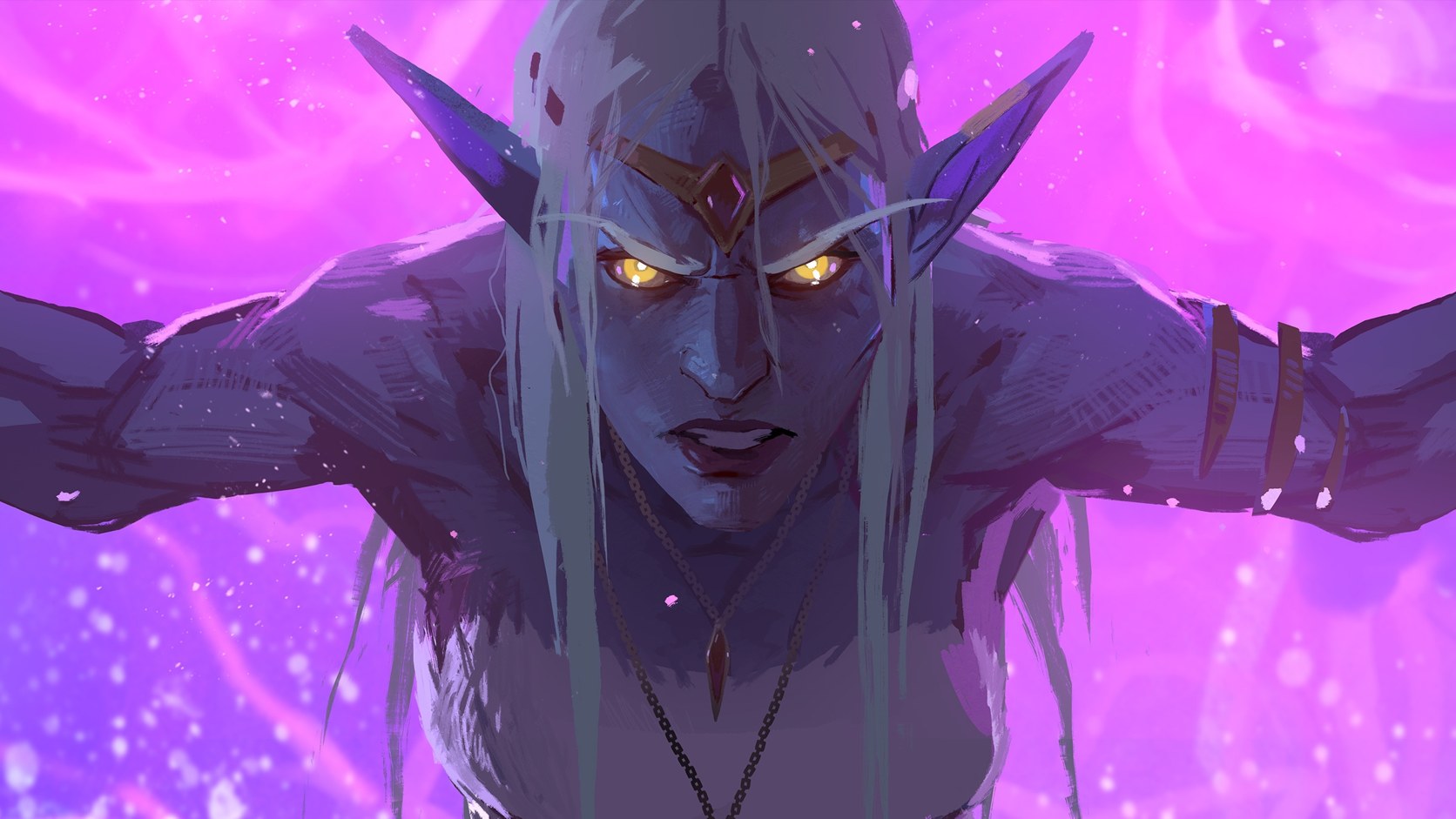
Azshara survived through a different bargain. Blizzard’s Warbringers: Azshara shows her struggling to hold back the water before confronting N’Zoth’s offer. She insists on retaining her status as queen. Her transformation and that of her followers produce the naga, giving the destroyed empire an underwater successor. N’Zoth is an Old God with his own interests, distinct from the Burning Legion whose arrival she had encouraged.
Illidan creates another Well
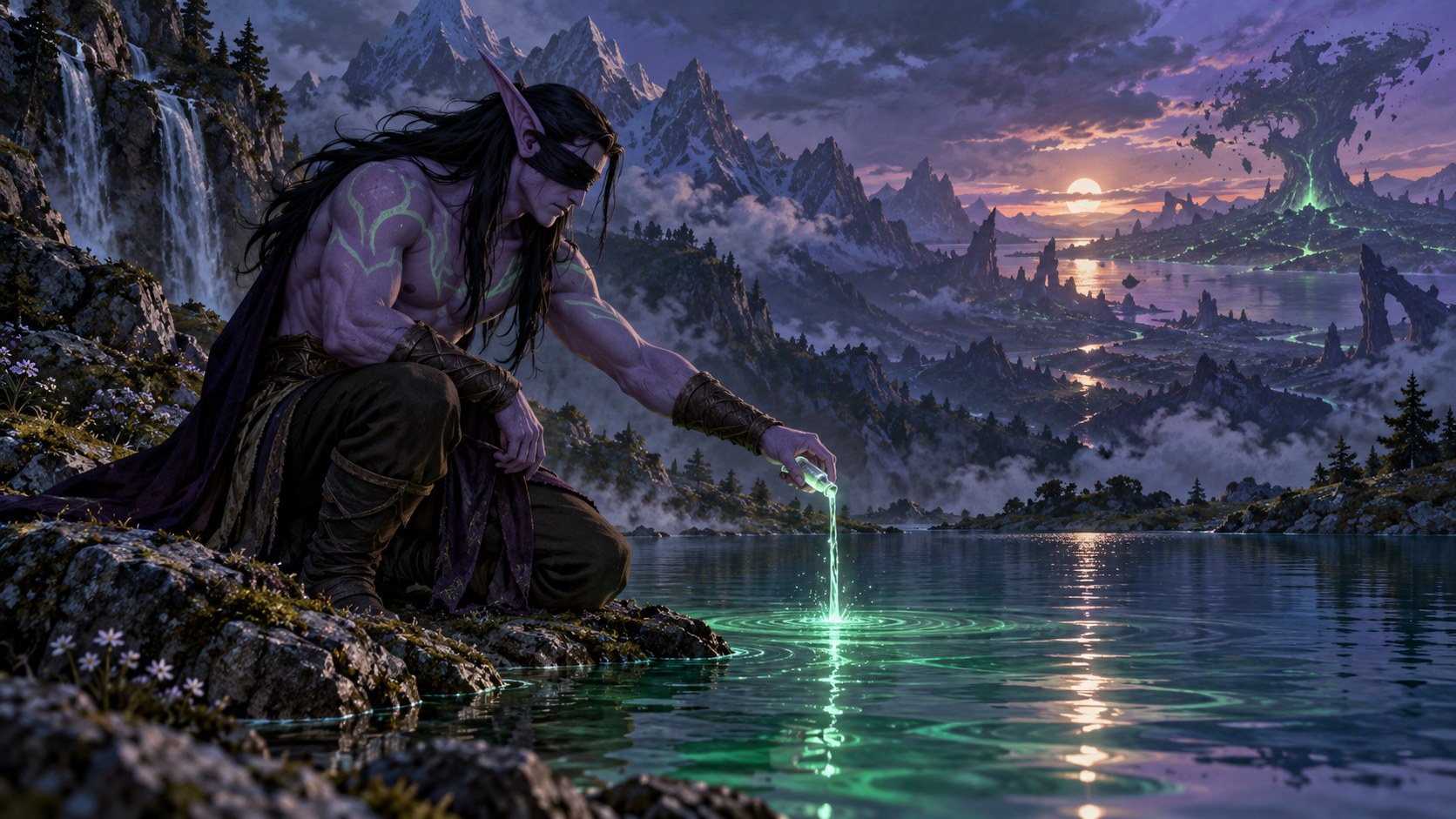
Illidan had saved water from the original Well. After the catastrophe, he poured three vials into a lake on Mount Hyjal, creating a second Well of Eternity. He believed Azeroth would need its arcane power when the Legion returned. To survivors who had just watched their civilization collapse, restoring that source of power was intolerable. His actions helped lead to his long imprisonment.
The surviving Aspects addressed the new Well by growing Nordrassil above it. Alexstrasza planted the tree; Ysera linked it to the Emerald Dream; Nozdormu’s blessing granted the night elves immortality while the tree endured. The settlement shaped their life through the Long Vigil.
The Highborne’s eventual exile belongs to the later aftermath. Dath’Remar’s followers resisted the rejection of arcane magic and ultimately left Kalimdor, becoming ancestors of the high elves. Compressing that separation into the day of the Sundering loses the centuries of disagreement that followed the war.
Visiting the war in World of Warcraft
Cataclysm’s Well of Eternity dungeon gives players a separate journey into this past. Nozdormu sends adventurers to recover the Dragon Soul for the fight against Deathwing in their own era. They encounter younger versions of Illidan and Tyrande, confront Azshara’s forces and battle Mannoroth and Captain Varo’then near the Well.
The mission does not erase the Sundering. Its purpose is to obtain an artifact while preserving the history on which the present depends. That distinction also separates the dungeon’s visitors from the travelers in Knaak’s trilogy.
Beyond the dungeon, Azsuna’s ghosts, Highmountain’s ancestral stories and the naga all preserve different consequences of the conflict. The War of the Ancients explains why so many WoW locations contain people still living with decisions made ten thousand years earlier—and why defeating the Legion could never restore the world exactly as it had been.
Sources
Blizzard: Well of Eternity dungeon preview and Warbringers: Azshara provide the official dungeon context and the queen’s later cinematic portrayal. Blizzard’s Azsuna zone preview discusses Farondis’ rebellion.
For the broader chronology and individual episodes: Warcraft Wiki’s War of the Ancients, Jarod Shadowsong, Huln Highmountain, Demon Soul, Sargeras and Highborne entries collect references to novels, quests and historical publications.
Illidan’s motives are described in the archived Warcraft Encyclopedia entry. The second Well and the Aspects’ response are covered by Well of Eternity on Hyjal and the in-game text The World Tree and the Emerald Dream. The time-travel episodes follow Richard A. Knaak’s War of the Ancients trilogy, summarized in the novel account.