Late-September reports put Asmongold’s Olympus close to 50,000 members. Even with the qualifications that figure needs, the guild network has become large enough to change how other people play the World of Warcraft: Forever beta. Some want to march with it. Others are choosing Horde, organizing their own groups or installing an addon that filters Olympus out of their conversations.
The result is a conflict over who gets to shape a shared world. A streamer can assemble a crowd that fills streets and roads. Players outside that crowd can fight back, leave, or make tools that let them carry on without reading its messages. Forever has given all of them more reasons to encounter one another, weeks before launch.
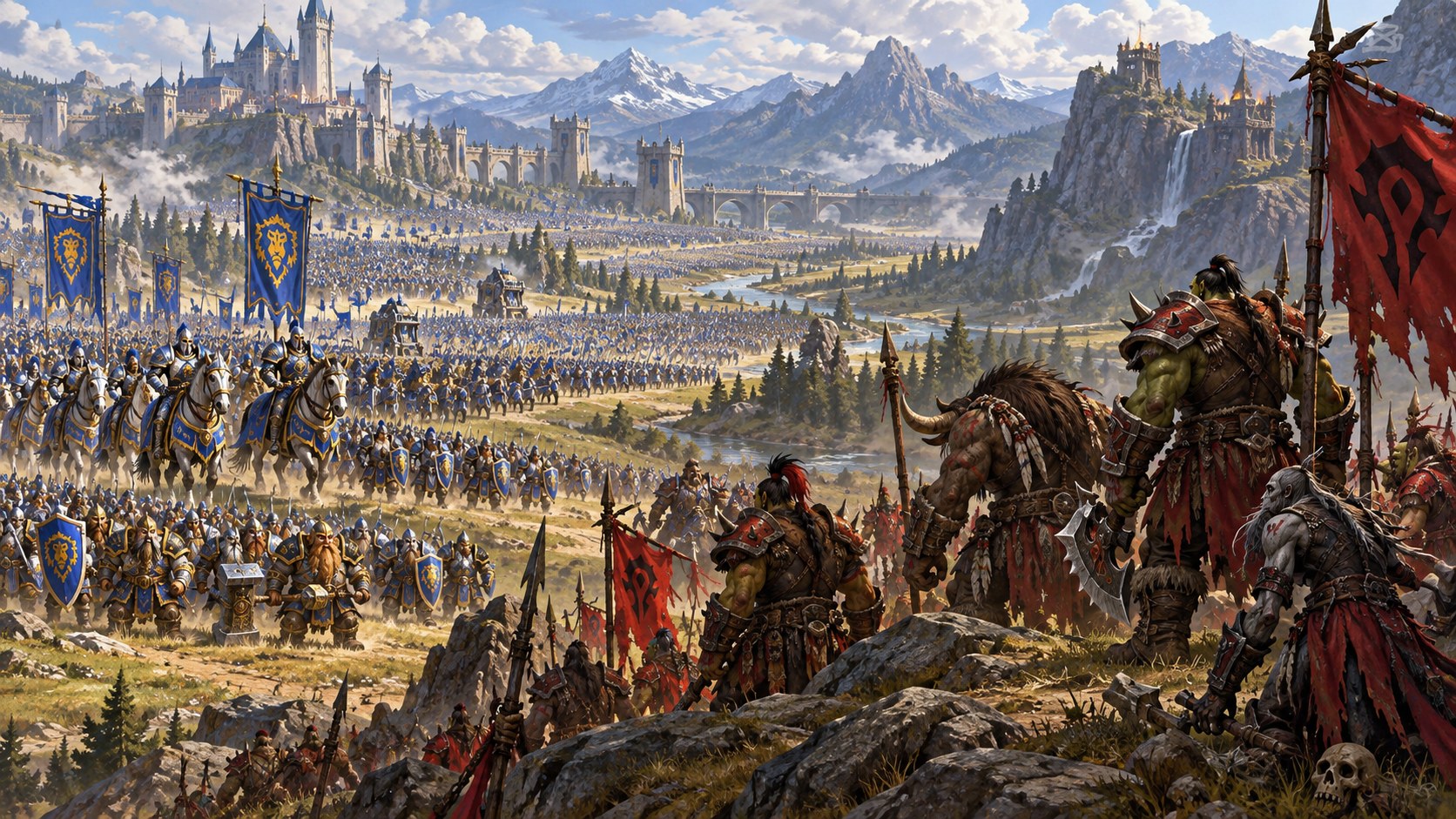
Reporting checked Oct. 4, 2026. The cover is an original conceptual illustration created with ImageGen; it does not depict a recorded battle or establish the size of any in-game army.
How Olympus reached the tens of thousands
The strongest dated statement from Asmongold himself is his Sept. 23 announcement: “Olympus now has 30+ full guilds with over 30,000 members.” His post on X, reproduced in contemporary coverage, describes a federation rather than one enormous guild. Later, UDN Game’s Sept. 29 report cited an addon tally above 45,000, with more than 5,000 online at one point. PokeIndie’s Sept. 30 account described the network as closing in on 50,000.
That is the basis for the roughly 50,000 figure circulating around Olympus. A verified count of 50,000 distinct people would require information those sources do not provide. Guild rosters contain characters, including possible alts. A federation total, its online population and the number present in one fight are three different measurements.
The growth method is much easier to establish. An individual guild has a 1,000-character limit, so recruitment continues through additional Olympus guilds. A new member can join whichever branch has space. Each branch has its own leadership, while the shared name and Asmongold’s broadcasts give the collection a recognizable identity. The Olympus addon’s documentation explains both the limit and the problem of keeping track of so many separate rosters.
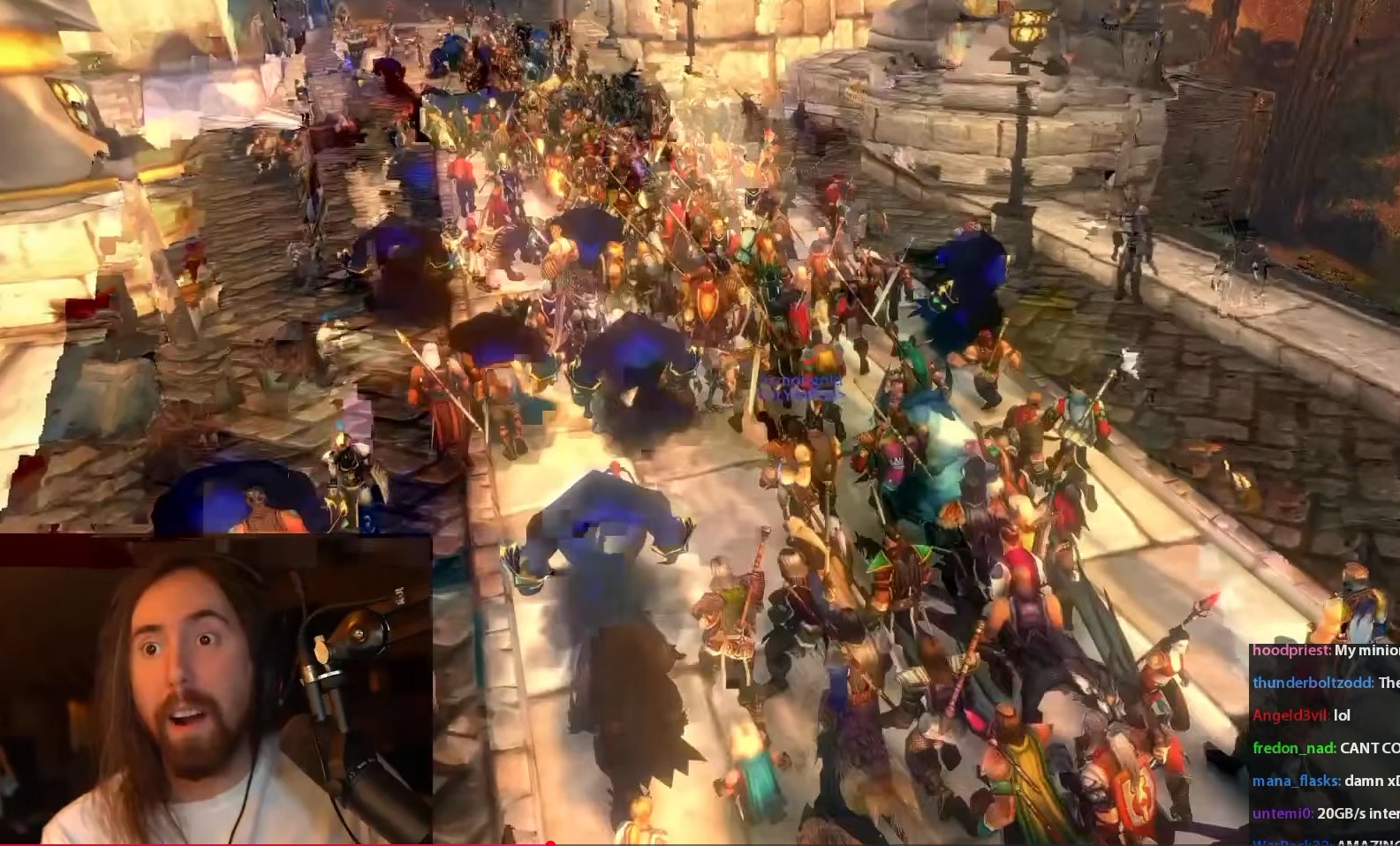
Recruitment on this scale changes what joining a guild means. A player can turn up for the spectacle before knowing anyone in their branch. The attraction is immediate participation in something recognizable, with a leader whose next destination is publicly visible. Membership becomes accessible to people who would never apply to a progression roster or commit to a fixed raid schedule.
That also explains why the total should be treated as evidence of reach. Whether those characters become regular participants will depend on attendance, branch leadership and how much activity continues when the stream ends.
The plan is to keep bringing more people
Asmongold’s recruitment ambition is explicit. A Sept. 25 clip, documented by WoWSoD Pro, has him saying: “Every single person on the server needs to be in Olympus.” His published videos make the same enthusiasm for scale clear. One is titled “30,000 PEOPLE AND GROWING... WE CAN’T BE STOPPED”, listed with his other beta broadcasts on the unofficial Olympus fan site.
“Zerg” is a useful description of the approach, provided it is understood as our description rather than an invented quotation. Bring enough people to overwhelm an encounter, absorb losses and keep going. In its report on the large expedition, UDN describes players combining stuns, pets and repeated resurrection to take on elite enemies far above their level. Numerical strength lets a low-level crowd attempt something that would defeat an ordinary leveling party.
The same outing supplies a less flattering demonstration of collective obedience. On the journey toward Menethil Harbor, Asmongold jumped from a cliff and died. Followers jumped after him, leaving paladins to revive the casualties. The incident appears in coverage of his Sept. 27 raid video. The group’s willingness to follow made the event possible and made the mistake much bigger.
For a rival group, this suggests where a numerical advantage could become vulnerable. An army still has to reach the fight together. Players need directions, healers need protection, and reinforcements need a destination. A larger roster cannot guarantee that everyone follows the same call at the right moment.
The addon that helps a crowd act together
Olympus has player-made tools for that coordination. Its addon combines reports from separate guilds into a census, distinguishes total membership from members online, and helps locate branches with recruitment space. Shared channels and rally alerts allow communication beyond a single guild roster. It also helps members request a group invitation to reach the layer where Asmongold is playing. These functions are described by the developer, not independently measured performance guarantees.
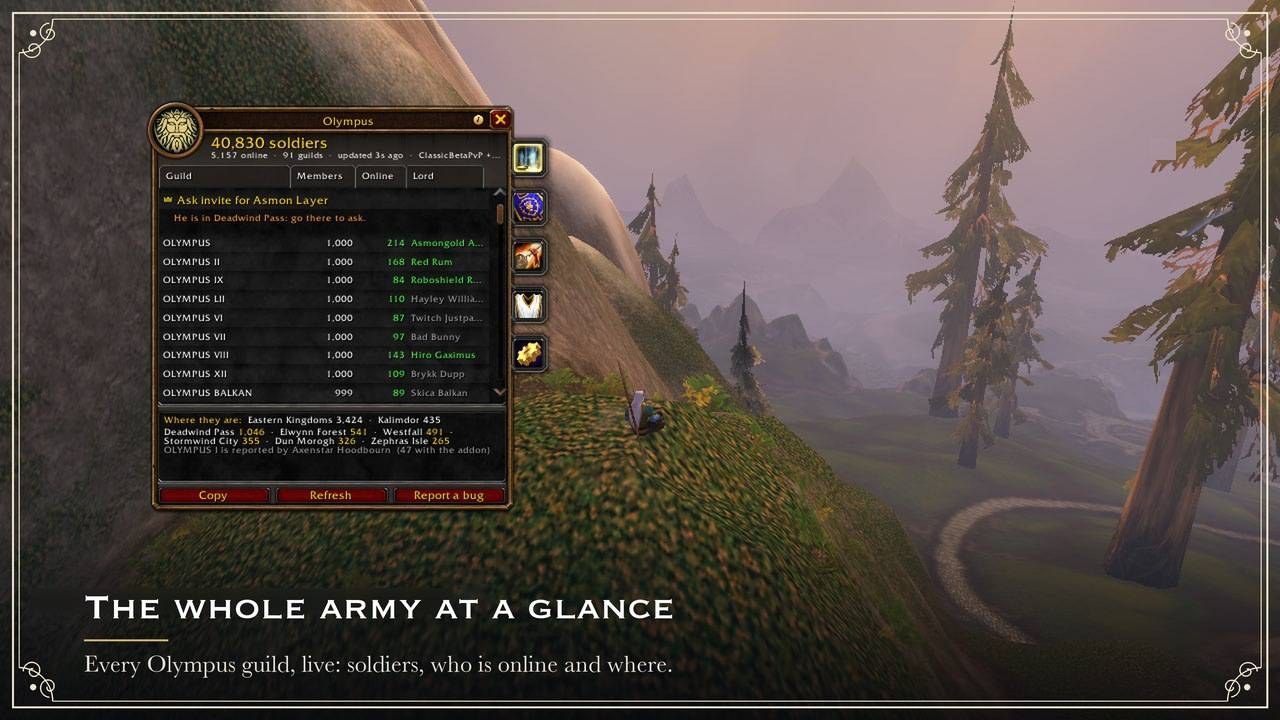
The significance extends beyond convenience. A collection of full guilds needs ways to find available people, pass on a location and know who can answer for another branch. The addon provides some of that structure. A rival organization would have to solve comparable problems even if it used different software.
There is a limit to the picture of two neatly separated camps. The developer also documents support for Olympus guilds on Horde, with faction-specific information. A Horde character is therefore not automatically an opponent of Olympus. Guild affiliation, faction choice and a player’s feelings about a streamer do not always line up.
Sodapoppin’s objection starts in chat
Sodapoppin has supplied one of the clearest public criticisms. In a Sept. 23 clip covered by NDTV, he described Olympus players as “very obnoxious” and “very spammy.” His complaint concerned the constant presence of the community in public channels and requests to join Asmongold’s layer. He also allowed that some participants might be exaggerating their behavior for the joke.
That criticism concerns the everyday experience between battles. Trade chat is also where someone looks for a service or a group. A huge recruitment campaign can make those ordinary uses difficult even when most members never send an offensive message. The people enjoying a gathering and the people trying to use the same city can have very different experiences of it.
Some players have responded by choosing Horde. In a Sept. 30 Blizzard forum discussion, one poster said avoiding Asmongold’s followers was the reason for that choice. Another immediately pointed out the existence of Olympus guilds on Horde PvE. The exchange illustrates both the desire for distance and the difficulty of obtaining it simply by changing factions.
These accounts establish dissatisfaction among identifiable players. They cannot tell us what proportion of the beta population shares it, or how many people changed their plans because of Olympus.
The Horde response is taking shape in the field
Savix’s beta footage shows the more entertaining response to a crowded world. In “WORLD PVP IS BACK IN FOREVER CLASSIC | NO LAG”, his Horde group moves through a sequence of open-world fights. Kami-Labs’ Sept. 23 account describes an early victory, a retreat under pressure from guards and an extended confrontation around a boat. When the group needs help, French players arrive as reinforcements and turn the fight.
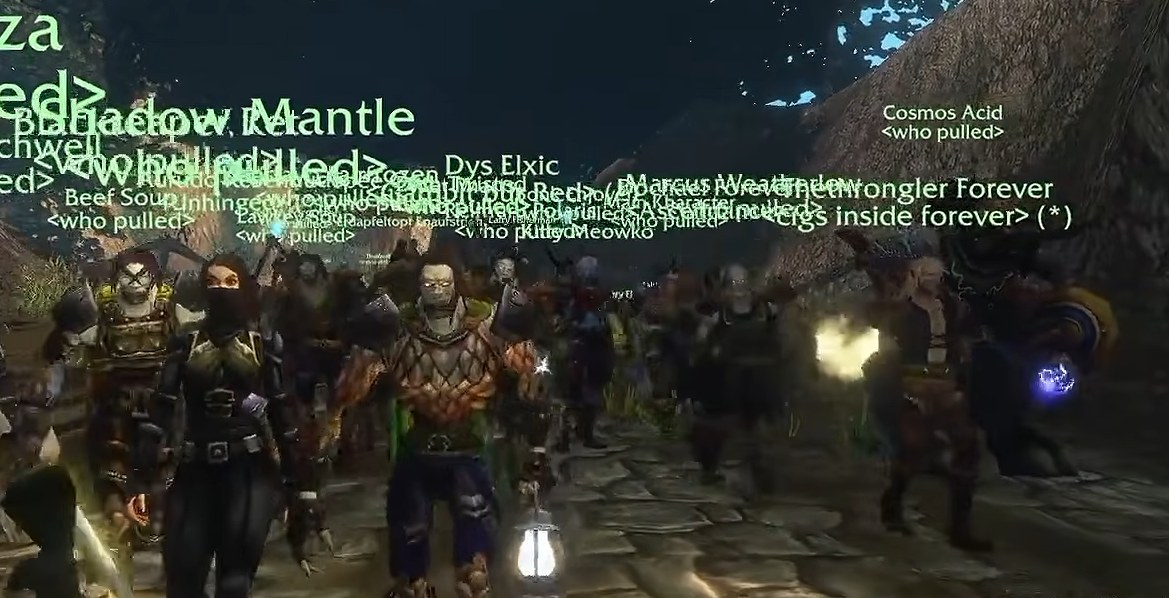
That is a concrete example of players combining forces when a fight demands it. It also gives the larger rivalry somewhere to develop. People who meet while defending a route or answering a call for help can become recurring allies. An opposing crowd provides a reason to exchange contacts and return together.
The evidence available for this article does not establish a single anti-Olympus coalition with an agreed roster of top streamers and a shared command. Sodapoppin’s criticism, individual faction changes and Savix’s battlefield cooperation should not be combined into a formal alliance announcement. They show several responses to the same crowded beta, with the possibility of more sustained organization.
A lasting coalition would need to do more than dislike Olympus. Its organizers would have to agree on meeting times, coordinate across guilds and keep people interested after a defeat. The first faction to manage that consistently could become a much more substantial opponent than a collection of angry replies.
OlympusMute makes the resistance visible
The most measurable response so far comes from an addon. OlympusMute, by Solastro_Gaming, filters communication from chosen guilds, with Olympus included by default. Its CurseForge listing showed 44,824 downloads when checked on Oct. 4. Download totals may include repeat downloads and updates; they are not a count of unique opponents or active users.
The tool can suppress messages and chat bubbles, filter chosen words, and reject supported invitations or interactions from identified players. It operates on the user’s client. It does not remove enemy characters from the world, prevent them from attacking or expel them from a server. Calling it a way to make Olympus disappear gives a misleading impression of what it changes.
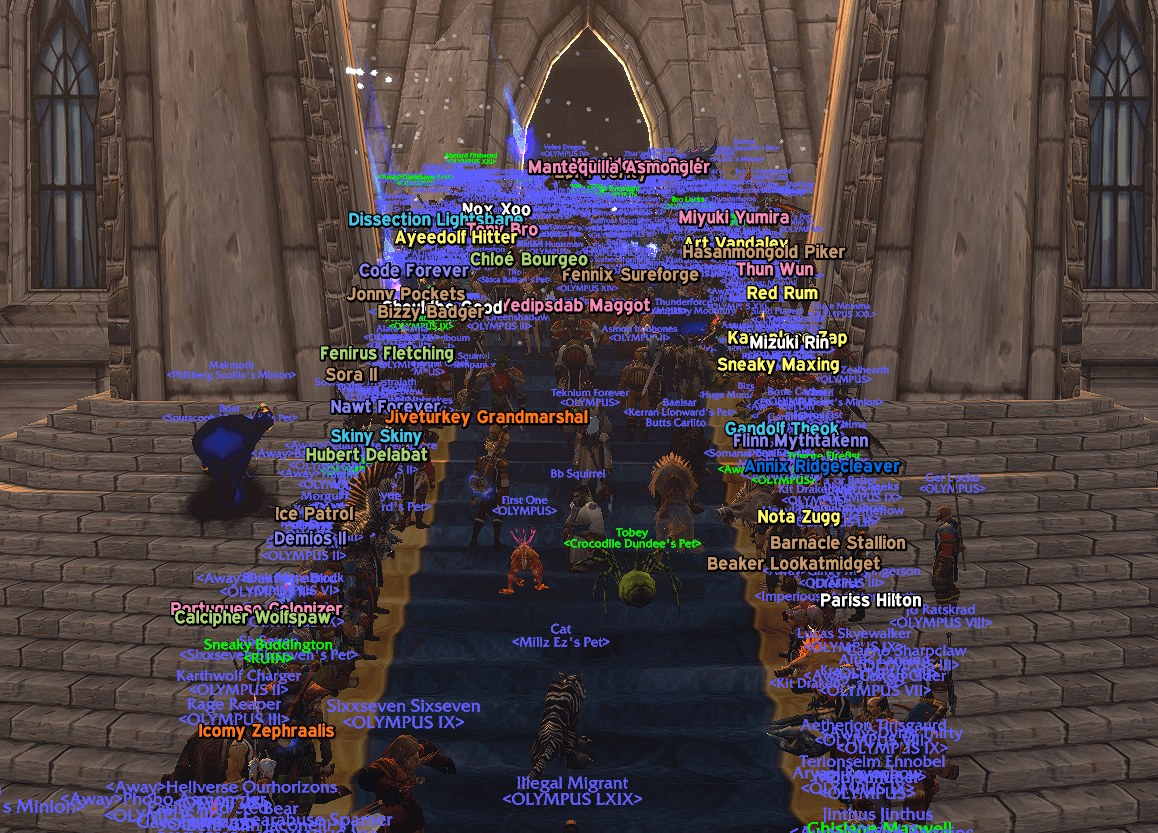
The creator’s background makes the story more interesting. 404 Media’s interview with Solastro describes a former Asmongold fan who became frustrated with public-channel spam. He explained that individually ignoring the participants was impractical at the scale he encountered. His solution let other players make the same choice without maintaining a separate list of every name.
For supporters, this is a way to recover control over their own chat. A player can continue questing on the same ruleset without accepting every message that a large community produces. The number of downloads demonstrates interest in that option, even though it cannot measure the full scale of the underlying behavior.
The argument over filtering goes both ways
Olympus members have raised a different concern. A Sept. 28 forum thread argues that guild-wide filtering affects people who have done nothing objectionable. Someone who joined to find dungeon groups can lose contact with potential teammates because of a tag beside their name. Other posters defend their ability to decide whose messages they see.
Both consequences follow from the design. Filtering by guild is efficient precisely because it does not evaluate each member’s conduct. That makes it useful to someone overwhelmed by messages and frustrating to a polite member caught by the same rule.
A small project called OlympusFans applies the opposite preference, allowing identified Olympus players through while filtering other players’ messages. Its listed audience was tiny compared with OlympusMute, so the two should not be presented as equally popular movements. Its existence nevertheless shows how quickly a dispute over chat can produce separate communication rules for each camp.
If such habits persist, they could affect grouping and trade as well as arguments. Players might occupy the same city while hearing increasingly different conversations. That would complicate the social freedom promised by a larger shared population.
A larger world still has layers and limits
Forever’s approach to realms makes these encounters more consequential. Players choose rulesets rather than an old-style list of named servers, as explained in WoWSoD Pro’s breakdown of the system. A community with a large presence is harder to avoid by selecting another familiar realm name. At the same time, layers divide a zone’s population into separate copies.
Those copies matter when imagining future battles. A network with tens of thousands of roster entries does not imply that all those characters can meet on one battlefield. The existence of tools for finding Asmongold’s layer is itself evidence that being in the same broader population is insufficient.
The early results are encouraging in places and uneven in others. Kami-Labs highlights responsive combat in Savix’s footage, while UDN reports lag and rollbacks during the Olympus expedition. Different crowds, locations and moments can produce different outcomes. Neither account establishes an unlimited capacity for stable mass combat.
Blizzard is still changing the limits. On Sept. 27, Holly Longdale wrote that the beta’s population cap had been raised again, a statement reproduced by GamesRadar+. That confirms further capacity work. It does not specify how many combatants one zone layer can sustain.
Twitch is already treating the beta like a major release
The attention is substantial even by WoW standards. Icy Veins’ comparison of launch-era viewing figures reports a peak around 800,000 during the Forever beta opening period, using TwitchTracker data. For perspective, TwitchTracker’s World of Warcraft page records the category’s all-time peak as 1,135,186 on Aug. 26, 2019, at the Classic launch.
The beta therefore belongs in the conversation about major WoW streaming moments. The comparison needs one qualification: World of Warcraft category totals can include broadcasts of other versions. They should not be relabeled as an audited Forever-only audience. Concurrent viewers are also a different measure from players online or total hours watched.
Even with those distinctions, the relationship between audience and action is easy to see. A public march gives viewers a reason to watch. Some viewers join the next gathering, making it larger and giving rivals another target. A defeat, rescue or spectacular mistake can become the reason people return for the following stream.
What would make this rivalry last
Blizzard’s What’s Next recap describes a world without flying or level scaling, with renewed emphasis on preparation and cooperation. Those choices leave room for geography to influence player conflict. A defended crossing, an exposed approach to a dungeon or a reinforcement group arriving by boat can affect an encounter before the first attack lands.
The prospect is an extended sequence of player-made events. A guild organizes a march; opponents learn its route; smaller groups arrange support; a failed defense produces another attempt. Such encounters can give people reasons to remember particular places and particular rivals. They do not require everyone on the server to appear in the same frame.
For that to remain enjoyable, both sides need opportunities to participate. A permanently one-sided fight gives the weaker group little reason to return. Repeated harassment of uninvolved players can drive away the population that makes the world interesting. Leaders who want a lasting rivalry will need to distinguish a willing opponent from someone simply trying to finish a quest.
Olympus has demonstrated an extraordinary ability to attract attention and assemble people. Other players have demonstrated that they will answer on their own terms, through faction choices, battlefield cooperation and software. The launch will show which of those responses develops into a durable community. For now, Forever’s beta is already producing stories whose outcome belongs to the players.
Sources and image credits
Membership and recruitment: Asmongold’s Sept. 23 statement, WoWSoD Pro’s dated roundup and clip links, UDN Game’s expedition report, and PokeIndie’s Sept. 30 summary. Later unofficial estimates are not treated as audited unique-player counts.
Streamers and community: Sodapoppin coverage with the original clip embedded, Savix’s world-PvP video, Kami-Labs’ account, and the player discussions linked in the relevant chapters. Forum posts represent their authors, not Blizzard or a population survey.
Addon documentation and galleries: Olympus Guild on GitHub, Olympus Guild on CurseForge, OlympusMute, OlympusMute gallery, and OlympusFans. Creator background: 404 Media’s interview.
Four documentary images come from Asmongold and Savix footage reproduced by Kami-Labs, and the addon developers’ published galleries. The generated cover is an original Azeroth Chronicle conceptual illustration. All game imagery and interface elements belong to Blizzard Entertainment. Viewing statistics, server changes and game-design sources are linked alongside the claims they support.