World of Warcraft: Forever finished its beta on Oct. 23, 2026, with five weeks of testing behind it and a particularly unruly farewell. The strongest reason to follow it into November is the prospect of a busy Azeroth where people have reasons to meet, stay together and return to the same places. New lighting helps. New dungeons help more. The people filling those spaces will determine whether this becomes a lasting home.
The beta also left limits on what anyone can conclude. Public leveling stopped at 30. Endgame balance remains largely ahead of us. Performance improved, but accounts of smooth mass gatherings coexist with documented connection failures and problems keeping groups on the same layer. Those limits matter when separating a successful introduction from a verdict on the complete game.
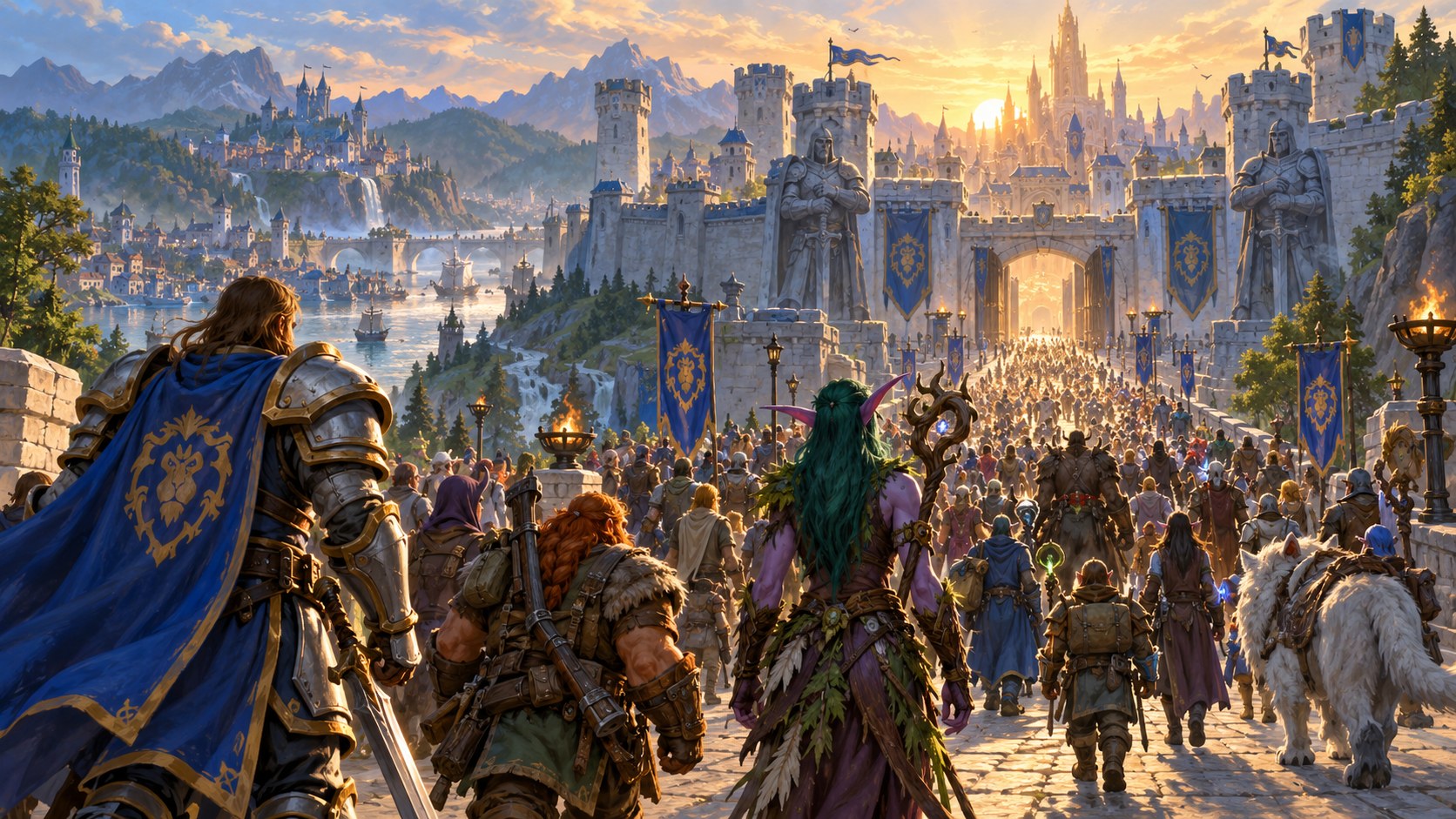
Reporting checked Oct. 25, 2026. The cover is an original AI-generated editorial illustration, not a screenshot or a reconstruction of a recorded gathering.
The farewell that turned starting zones into battlefields
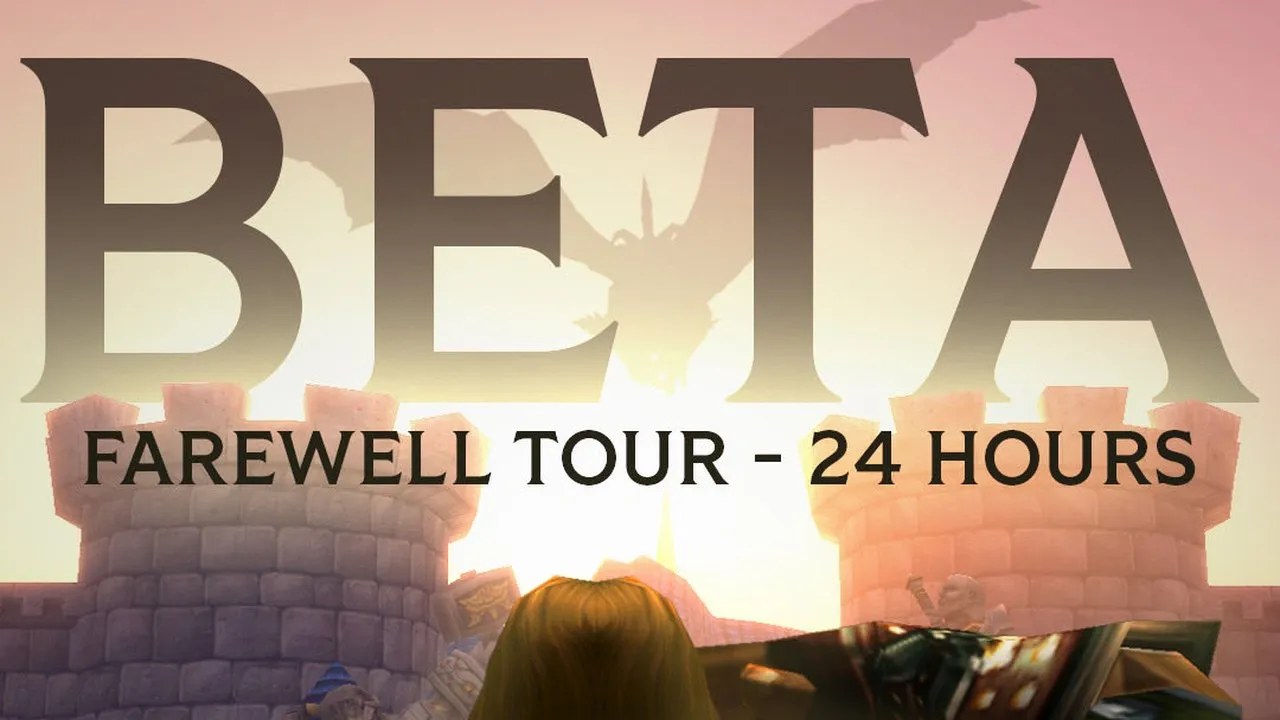
Blizzard confirmed the shutdown at the end of the test on Friday, Oct. 23. The scheduled closing time was 10 a.m. PDT, or 7 p.m. CEST in Central Europe. Before that came a full day of celebrations, beginning Oct. 22, across Zephras Isle, Dun Morogh, Elwynn Forest, Teldrassil, Durotar, Tirisfal Glades and Mulgore.
The choice of starting zones made participation easy. A player did not need a finished character or a raid invitation to reach the event. Blizzard’s invitation explicitly warned that its unusual items and experiences would almost certainly be absent at launch. The normal rules of progression were being suspended for the goodbye.
According to Wowhead’s final-event report, vendors outside capitals offered fireworks, a group speed scroll and a potion granting 200% additional experience. Azuregos, Lord Kazzak, Thunderaan, Voracious and a giant version of Hogger appeared in starting areas. Their rewards included Thunderfury and Sulfuras, while ordinary enemies could supply Classic Tier 1 equipment and Molten Core weapons. Contaminated crates then brought back the Scourge plague associated with the 2008 pre-expansion event.
That sequence gave the last day a character of its own. Gear normally associated with long raid campaigns became something to try before the servers closed. Familiar beginner territory became dangerous for entirely different reasons. The spectacle also interrupted ordinary testing; a final celebration and a useful last evening of low-level questing were not necessarily compatible for every player.
A crowded world became believable, with important qualifications
Forever’s population is the most immediate part of its appeal. Instead of choosing from a long realm list, players choose a ruleset. Blizzard describes each as a large player ecosystem. Friends still need to choose the same ruleset to group and run instances together; a shared game name does not mean every character belongs to one unrestricted worldwide population. The official ruleset overview also describes language preferences intended to help people encounter others they can communicate with.
The closing stretch supplied encouraging accounts of performance under load. In an Oct. 21 stress-test discussion, players described busy starting areas without queues or noticeable ability delays. One reported entering minutes after opening and playing the full four-hour test without lag. Another could not reliably meet friends despite group invitations. In a separate discussion of mass PvP, a participant described broadly stable fighting alongside disruptive changes between layers. These are individual experiences, not a representative performance survey.
The hardware distinction matters. Blizzard’s stress-test announcement specified that Oct. 21 would use the regional hardware intended for launch. The ordinary beta went offline for that test and reopened afterward. That makes the stress test particularly relevant to November, while leaving plenty of uncertainty about the larger launch audience.
It would be inaccurate to describe the entire beta as almost lag-free except around Olympus. Tom Ellis’ explanation, reproduced by Wowhead, covered early disconnects, queues and loot delays. PC Gamer’s European report described severe latency spikes before a fix and a connection workaround. Those failures affected people far beyond any streamer’s guild.
What the later reports support is a more useful conclusion. Heavy attendance and playable questing can coexist in Forever. They do not establish an unlimited number of combatants in one location, a verified regional concurrent-player total or a guarantee of a smooth release night.
Olympus showed both the attraction and the cost of scale
Asmongold’s Olympus network made crowds visible even to people who never joined the beta. It also demonstrated why population totals require careful wording. A network’s character roster, the number of distinct people behind those characters and the number fighting in one place at the same moment are three different measurements. Reports of tens of thousands of members cannot be used as proof that tens of thousands fought simultaneously without lag.
The documented dispute around Olympus involved crowded areas, chat disruption, invitations and complaints about some members’ behavior. It became a dispute over how other players could preserve their own experience in the same world. Our earlier Olympus feature examines the guild network, its critics and the communication-filtering addon OlympusMute.
A large, recognizable organization gives world PvP potential beyond a spontaneous skirmish. Rivals can recruit, choose routes, plan defenses and remember one another. The same concentration of players can also make an area unpleasant for someone trying to finish a quest. Server responsiveness is only one part of that problem. Fair faction participation, moderation and reliable grouping matter just as much.
Olympus therefore belongs in a beta retrospective as an example of what a larger shared population makes possible and what it makes harder. Blaming every delay on its members would give us a less accurate account of the test and an inadequate explanation of the work Blizzard still has to do.
The community returned to the center of the game
The renewed interest is visible in the kind of experiences people describe. In the closing forum thread, players thanked the team, looked forward to returning and traded memories of the farewell. One described a gnome and an undead character dancing together. Those anecdotes are small, but their subject is significant. Players were talking about someone they encountered, rather than only the rewards they collected.
“The community has returned” is best understood as an assessment of that renewed enthusiasm. It cannot mean that every player felt welcome or that old social problems disappeared. A busy chat can contain help, guild recruitment and abuse in the same minute. A popular streamer can bring friends back while making other players reluctant to use the same ruleset.
There was also a concrete example of collective feedback changing the product. On Oct. 22, Josh Greenfield announced that Roleplay-PvP would be available at launch, following further internal discussion and player feedback. The replies included celebrations and requests to enforce roleplaying standards. The community had secured an option it wanted and immediately started discussing how to make it work.
That is a stronger sign than a single viewing spike. People were choosing where they would play, whom they would play with and what conduct they expected. Whether those groups survive the first month will tell us more than their excitement during a temporary test.
Horizontal growth still leaves room for stronger gear
Forever’s direction is built around continuing to develop the original world at level 60. That changes the purpose of a new zone. It can provide another leveling route, a profession destination or a place to revisit with an alternate character, without requiring a higher level ceiling.
The wording around progression needs care. In his PAX Australia interview, summarized by Icy Veins, Clay Stone clarified that horizontal development primarily means expanding the world and its activities. New raid tiers will still increase character power. The intention is to keep those increases narrow and preserve the usefulness of earlier equipment for longer. Some older items may remain desirable across multiple tiers; no promise makes every item permanently best in slot.
For a player, the difference concerns how much previous effort survives the next update. If an older dungeon continues to supply useful gear or profession rewards, groups have a reason to return. If a new leveling zone offers a different route for an alt, development benefits people outside the current raid tier. Those are meaningful goals even with some vertical gear progression intact.
The beta could introduce that philosophy, but it could not prove years of successful execution. Long-term item relevance depends on later raid tuning, new rewards and how players optimize their characters. A level-30 test cannot settle those questions.
Legacy gives another journey a purpose
The Legacy system gives account-wide recognition to activities across the game. Blizzard describes challenges, selectable perks and a separate reward track. Leveling other classes is encouraged, but the developers explicitly say that all character advantages can be unlocked on one character. Players who prefer one main are not being told to build an army of alts just to qualify.
The Deep Dive describes three initial trees: Professions, Adventure and Resourcefulness. Earned points are shared across alts, while each character allocates them separately. At launch, a character can spend 16 points, with up to 65 available to earn through challenges. Further accomplishments contribute to cosmetic and prestige rewards beyond that spending limit.
Examples make the intended benefits clearer. Well Rested improves rested experience, Bountiful Harvest helps gathering, and Reagent Economy can remove reagent requirements from class abilities. These choices affect how comfortably a character travels, crafts and prepares. They also give another trip through familiar zones a connection to progress already made elsewhere on the account.
The design could help keep lower-level areas populated after the initial rush. Its success will depend on whether another journey remains enjoyable when it is voluntary. An account system works best here when a player wants to try a priest, a new profession or another faction’s quests, rather than feeling obliged to repeat content solely to avoid falling behind.
Graphics change the atmosphere of familiar places
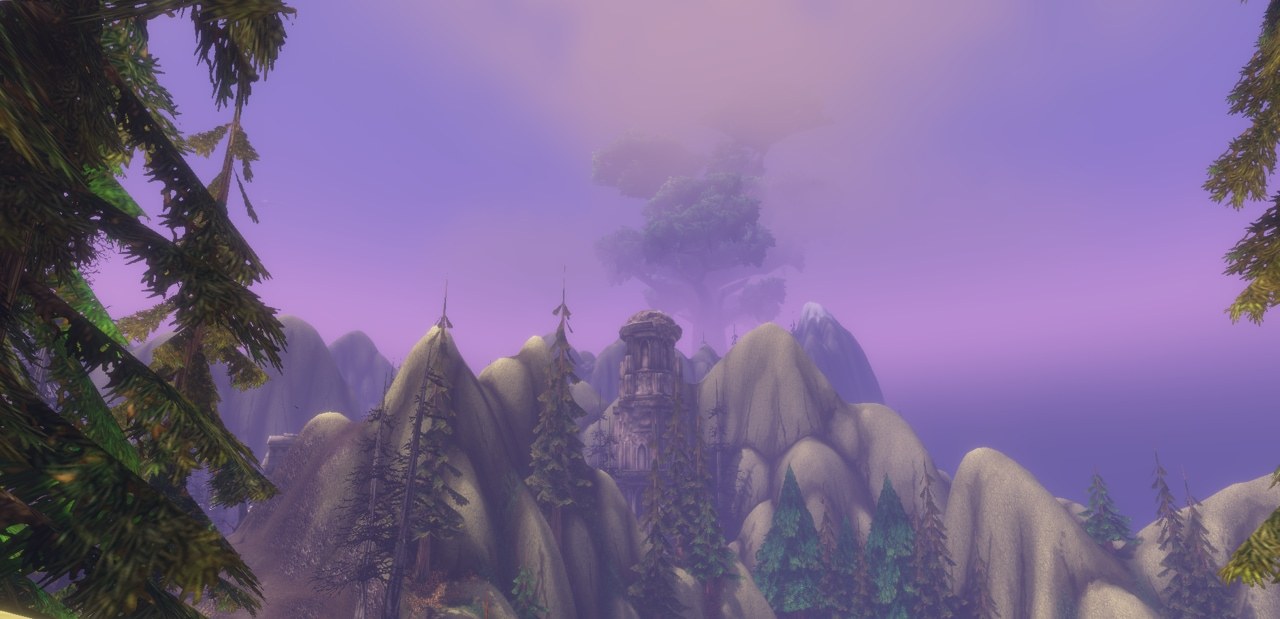
Forever’s visual update preserves recognizable Warcraft art while changing how the world is rendered. Blizzard’s “Evolving a Timeless World” presentation, documented with comparisons by Wowhead, concentrated on fog, lighting and water. The examples show why those systems matter even where the geography is familiar.
In the Wetlands, distant mountains can remain visible while fog gives the landscape depth. Shadows in the Badlands respond to the position of the sun rather than remaining fixed beneath structures. Ashenvale’s water flows downstream. Duskwood’s nighttime presentation puts much greater emphasis on darkness, mist and local light.
For someone who knows those roads, the attraction is recognition with more environmental detail. A new silhouette is not required for a familiar journey to look different. The effect is especially relevant to Forever’s emphasis on traveling through the world rather than treating it purely as the space between instances.
Players also have a choice of standard-definition and high-definition character presentation, alongside Classic and modern visual presets described in Blizzard’s overview. Skyborne are an exception to the available model choice: Blizzard says their SD characters and druid forms are planned for early 2027. These options should be assessed separately from server performance. A machine struggling to render a dense crowd or complex lighting can produce a poor experience even when the server responds promptly. Conversely, a high frame rate does not fix delayed abilities.
New music gives the expanded world its own identity
The audio story has a concrete addition that can already be heard outside the game. Blizzard released the Forever soundtrack in October, with music associated with Zephras Isle, the Riverglades and Mount Hyjal. Its official weekly feature credits Adam Burgess, Brendon Williams, David Arkenstone, Neal Acree and Jason Hayes, with Derek Duke as music director.
The track names move beyond broad regional themes to places such as Farholde Keep, Rog’mar Outpost, Mourning’s Rest and Malorne’s Retreat. That gives listeners a preview of how individual locations are being treated. The official listening page offers the album across music services.
Music has particular value in a game asking people to spend time on familiar continents. Reusing the setting does not require every new journey to have exactly the same accompaniment. New compositions can establish an area’s identity while retaining continuity through composers already associated with Warcraft.
This should not be inflated into a claim that every combat effect, voice or environmental recording has been rebuilt. The published soundtrack establishes substantial new music. A complete assessment of the audio mix across the level-60 game will require access to areas and encounters beyond the beta’s normal leveling range.
Camping makes professions useful to passing strangers
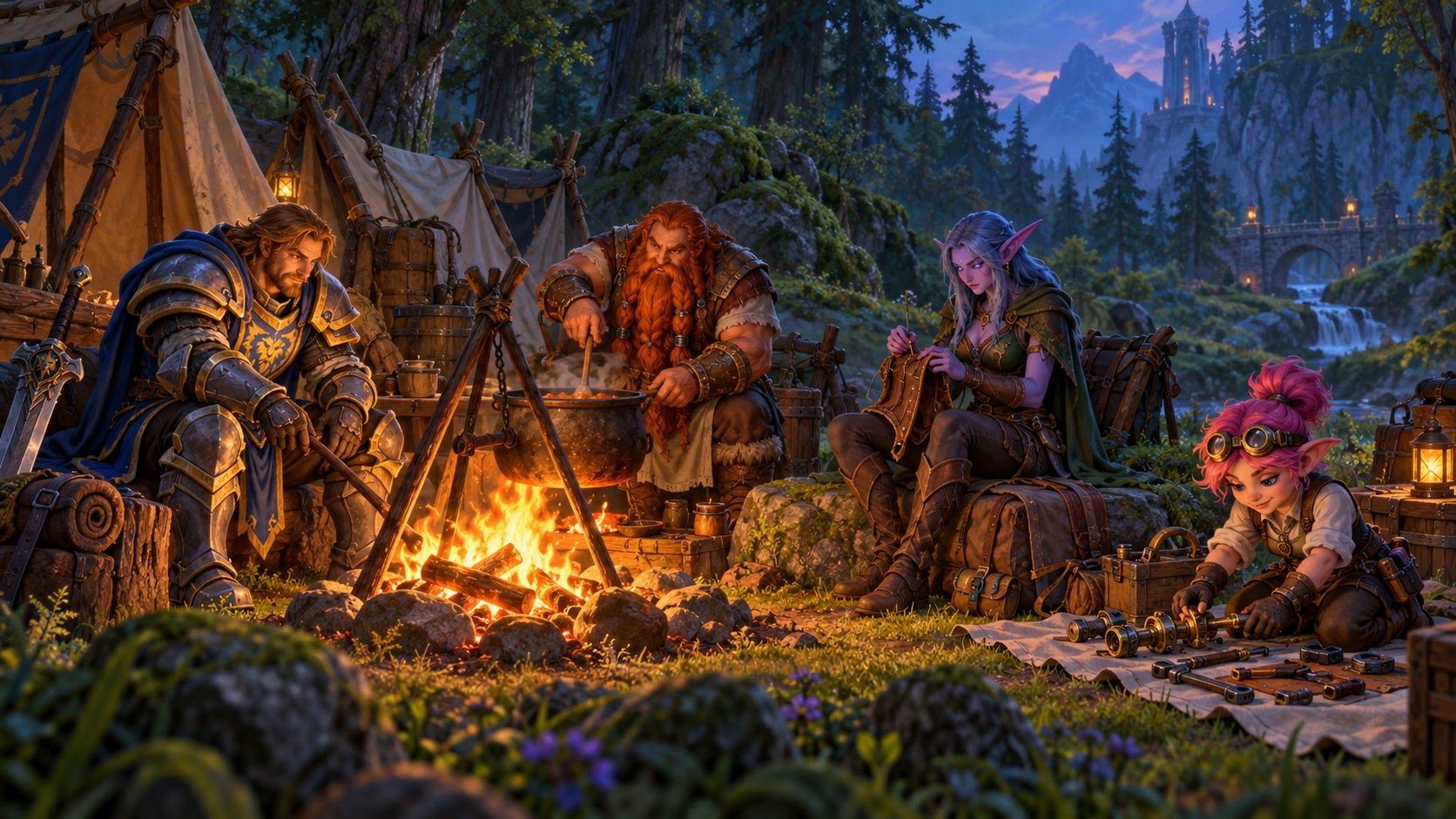
The camping system gives players a reason to pause together outside a city. As described in Blizzard’s camping preview, a Basic Campfire supports three profession-made features, with one contributed by each player. Improved fires can support five or 10. Spending at least a minute sitting or crafting at the site grants benefits from its features.
A blacksmith’s Sharpening Wheel supplies Strength; an herbalist’s Incense Candle supplies Intellect. An engineer can provide a Reagent Bot. These are useful contributions a traveler can recognize immediately. Class-equivalent buffs do not stack with their corresponding class versions, so a campsite does not provide unrestricted additional power on top of a fully buffed group.
The social effect follows from the mechanics. Players stop in the same place for a shared benefit, and professions make different people useful to the gathering. That creates an opportunity to ask about a nearby quest, trade materials or continue together. A conversation remains optional, which matters; a social system should give people reasons to interact without requiring a performance from every passing stranger.
Camping also creates decisions about location. A roadside gathering on a PvP ruleset can attract opponents as well as allies. Preparation takes place in the world where the adventure is happening.
Dungeons and classes give the return more substance
Blizzard’s October dungeon overview lists nine new five-player instances spread from level 13 through 60. Hall of Thanes begins beneath Ironforge; Ruins of Lordaeron uses the city above the Undercity. Excavation Site and City of Dalaran broaden the middle of the leveling journey. Later destinations include the Drowned City, Krol’dok Stronghold, Alcaz Prison, Blackmaw Hold and Shaper’s Terrace.
Dalaran illustrates how access can be part of the experience. Each faction has an introductory attunement route, and the dungeon opens through the sewers before taking groups into the city. Shaper’s Terrace connects its instance mechanics to power crystals collected in Un’Goro. These are ways to connect a dungeon to the surrounding world rather than making its entrance the only meaningful location.
The larger development plan also includes new and expanded outdoor regions. Blizzard’s What’s Next recap describes more than 1,000 new quests across levels 1–60, with places including Hyjal, Shen’dralas, the Riverglades and Zephras Isle. The beta’s level cap means those announcements should not all be presented as content players fully tested.
Class changes reach the early journey too. In the Paladin deep dive, Blizzard describes Holy Strike at level 6 and a Judgement that no longer consumes the active Seal. Protection receives more tools for threat, mana and survival; Holy and Retribution also gain new options. The familiar talent structure adds a 16-point milestone, and dual specialization becomes available at level 40.
Those examples show the intended scope of the revision. Players can recognize a class while having more to do with it. Whether every specialization earns a satisfying place in level-60 groups remains a separate issue from how enjoyable its first 30 levels feel.
What the beta still could not settle
The ordinary beta began with a level-20 ceiling and later allowed level 30, as recorded in Warcraft Tavern’s test archive. That limits conclusions about the complete game. Late-game professions, raid composition, mature economies and months of gear progression cannot be evaluated from early leveling alone.
Some problems were already specific enough to track. Blizzard’s Sept. 22 client update addressed Mac display and stability issues, controller navigation on character selection, and interacting with quest-starting items using a gamepad. A published fix records work done on those issues; it does not certify every hardware configuration or controller interaction.
The final closure message said the team would spend the following days concentrating on priority issues and the game service. That is consistent with a test that produced useful feedback and still left work before release.
Our assessment is cautiously positive. The beta made a convincing case for returning people to the original continents and giving them additional reasons to cooperate. Its strongest evidence concerns the early journey, community interest and improving performance. The long-term claim depends on what happens after players reach 60, after the opening excitement falls away and after the first new raid tier changes their priorities.
The release schedule, from names to the first raids
World of Warcraft: Forever launches globally on Wednesday, Nov. 4, 2026, at 3 p.m. PST, according to Blizzard’s launch announcement. That is 11 p.m. UTC on Nov. 4 and midnight CET on Thursday, Nov. 5, in Warsaw, Berlin and Paris. The European calendar date is therefore Nov. 5 even though the advertised global release date is Nov. 4.
The first scheduled step comes earlier. Early Name Reservation runs Oct. 27–Nov. 3 for eligible upgrade or Collector’s Edition owners. Blizzard lists a European opening at 6 p.m. CET on Oct. 27 and a separate North American opening at 1 p.m. PDT. These are regional start times, not equivalent time-zone conversions. Eligible accounts may create and name up to three characters in total across rulesets during this period. Names are allocated first come, first served; the reservation window provides character preparation, not an early start on leveling.
The two-name system makes the full first-and-secondary-name combination unique within a region. A favorite first name may remain usable with another second name. Players can hide the secondary name above their character in the world, although it still appears in chat.
Friends should agree on their ruleset before creating characters. Normal, PvP, Roleplaying and the newly confirmed Roleplay-PvP are planned for launch. Hardcore comes later. Blizzard said it was working to make Roleplay-PvP available for name reservation too; that part of the Oct. 22 announcement was still expressed as an implementation goal.
For installation, Blizzard directs players to select World of Warcraft: Forever from the Game Version menu in Battle.net. Do not treat an old beta installation or a name used during testing as a launch reservation. Blizzard explicitly wiped stress-test characters and names, and has not announced a transfer of ordinary beta progress. Plan a fresh live character rather than a continuation of beta gold, levels or equipment.
Base access is included with an active World of Warcraft subscription or game time. Optional editions provide additional benefits, including access to the Skyborne race and its Zephras Isle starting experience. Qualifying Invite-A-Friend codes give eligible recipients access during Nov. 4–11, under Blizzard’s stated restrictions. Buying an upgrade should therefore be a decision about those benefits; it is not required merely to enter the base game with an existing subscription.
Launch opens the journey to level 60. The first weeks give players time to level, develop professions, run dungeons and establish groups before the first raid opening on Dec. 9. There is no announced repeat of the beta farewell’s extraordinary loot distribution. Thunderfury from a temporary celebration should not shape expectations for normal live progression.
Blizzard’s raid overview confirms Barrow Deeps for 10 players, Hyjal Summit for 20 and Onyxia’s Lair for 40 on Dec. 9. All three are level-60 content. Barrow Deeps has eight bosses and entrances connected with Hyjal, Winterspring and Blackmaw Hold; Hyjal Summit has 13 bosses and multiple routes. Onyxia requires the Drakefire Amulet, earned through a faction-specific attunement chain and carried in the player’s inventory. Weekly resets are currently planned.
That schedule gives a new guild a useful sequence of decisions. Choose a ruleset and a faction together, settle into leveling groups, then decide which raid size the roster can reliably support. Ten friends and a 40-player organization will prepare differently, even though both are entering the same game. The beta generated the interest. November will show how many of those prospective groups become part of everyday Azeroth.
Sources and reporting notes
This feature combines the linked Blizzard announcements with Wowhead’s farewell and technical reporting, published developer-interview coverage, and clearly attributed player discussions. Individual posts illustrate experiences; they do not establish a population-wide verdict. Announced level-60 systems are distinguished from the beta’s playable leveling range. Dates and plans reflect information available on Oct. 25, 2026.
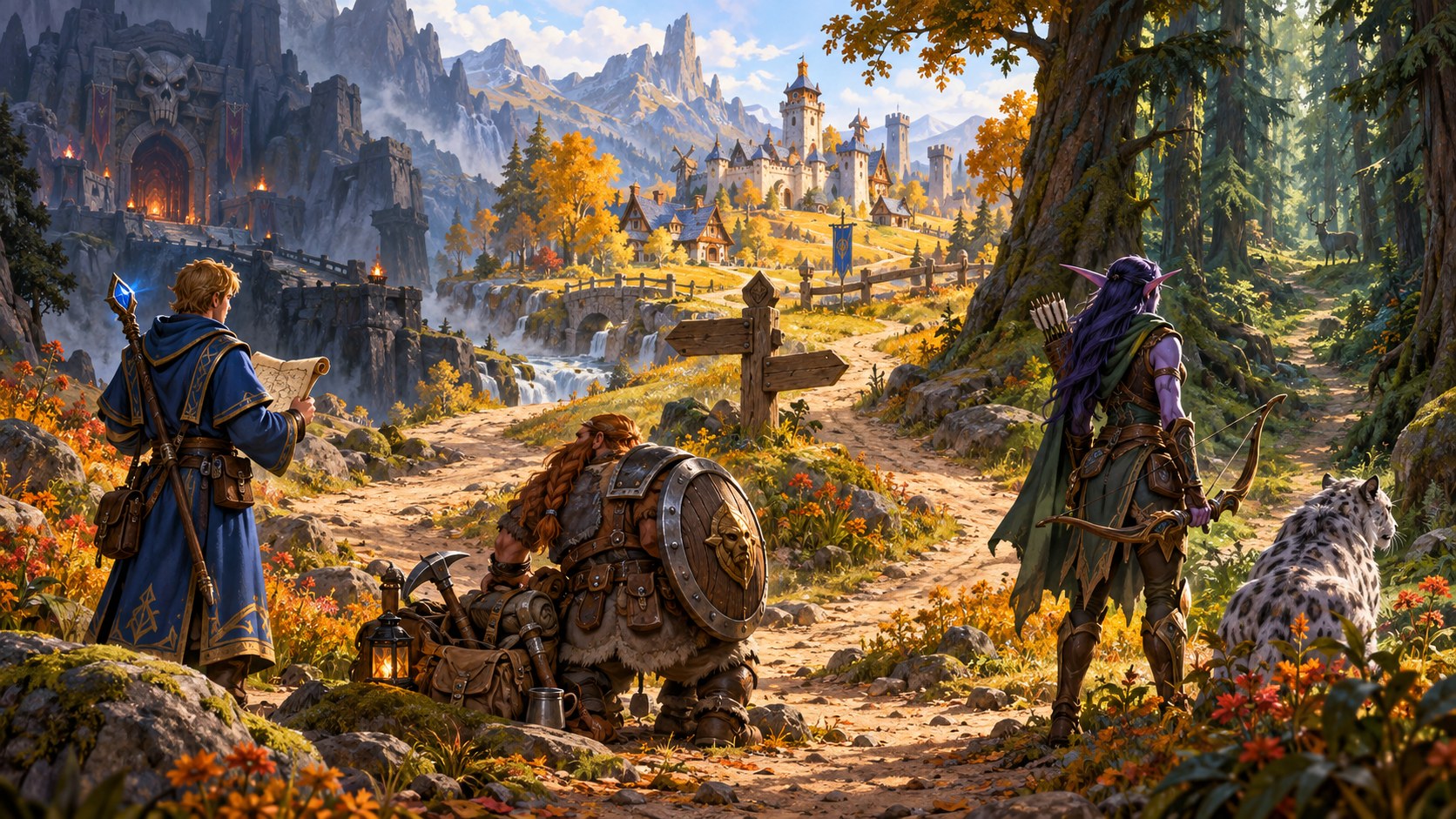
Image sources: Blizzard’s Beta Farewell Tour poster, reproduced by WoWForever.be, Blizzard’s Found Photos recap, and Blizzard’s dungeon preview. The cover, camping scene and alternate-journeys scene are original AI-generated illustrations.